The Millionaires Tax that passed the Washington State legislature funds significant expansions to our state’s Working Families Tax Credit (WFTC), an annual rebate of between $335 to $1,330 for households across our state. State Earned Income Tax Credits (EITC), like the WFTC, are a critical, proven tool to help families meet their basic needs and have long-lasting health, education, and employment benefits. The new expansions to the program will make the WFTC the most comprehensive and inclusive state EITC in the country.
Currently, around 350,000 households in Washington are eligible for the program. Under the new expansion, which will begin in 2029, 460,000 more households will benefit from the WFTC, meaning the tax credit will reach a total of 810,000 households, or over 1 in 5 households in Washington.
In addition, 352,000 more children would be eligible for the credit.1 This means that the program could cover about half of all kids in Washington (47%), up from 25%.
Who will benefit from an enhanced Working Families Tax Credit?
-
Lower-income seniors and young adult workers without kids at home
The Millionaires Tax removes an age restriction for households without dependents and allows all 18 to 24-year-olds and people aged 65 and older to qualify for the credit.
This expansion means that low-income college students, young adults exiting foster care, and working grandparents can receive a cash boost of up to $335. Only three other states have removed the age restriction for both younger and older workers in their state EITC. This expansion has been a policy priority for the Budget and Policy Center and our advocacy partners for many years (read more here).
Click on graphic to enlarge

-
Moderate-income households struggling to make ends meet
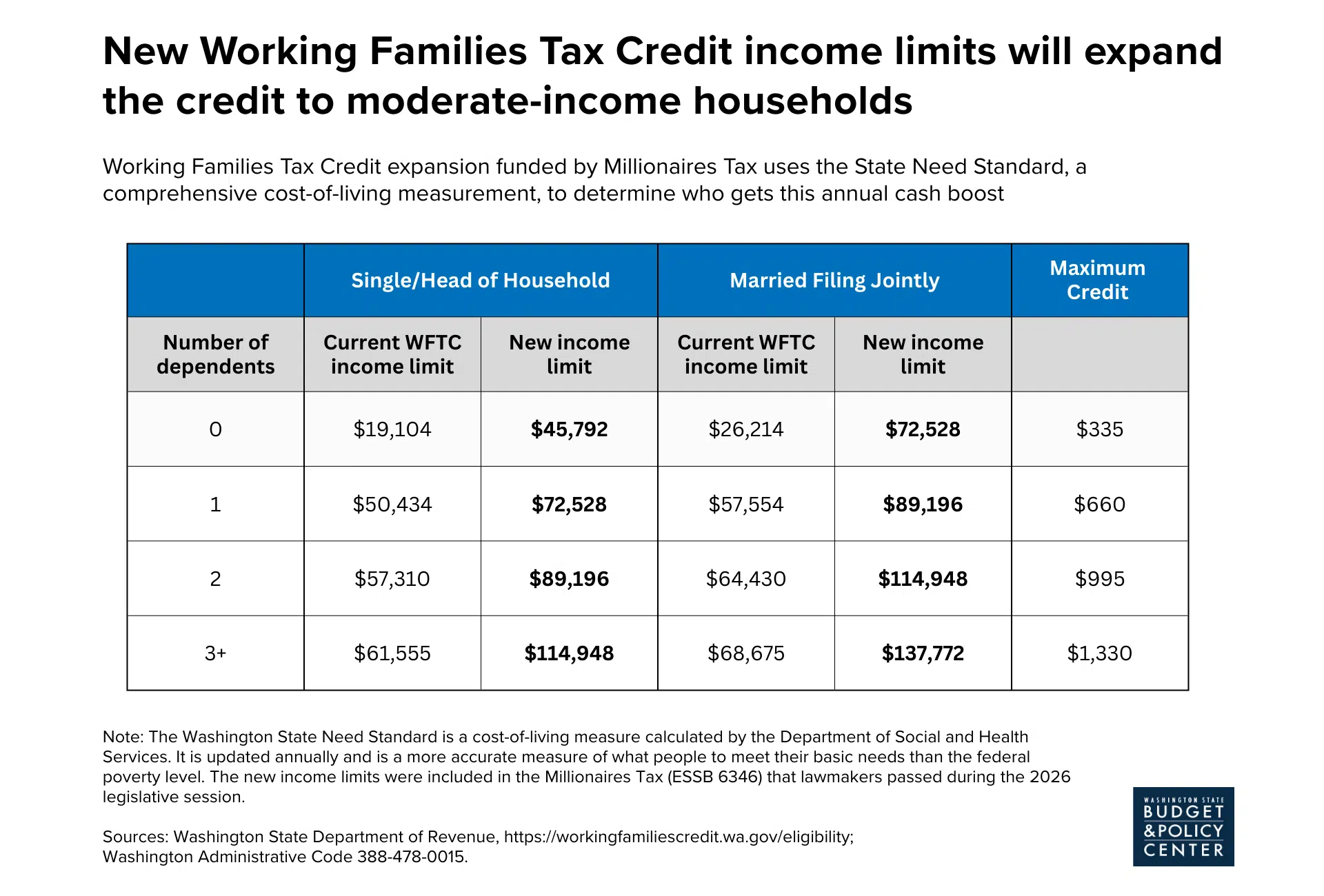
The Millionaires Tax also significantly increases the income eligibility to qualify for the WFTC. Currently, the income limits are based on the federal EITC program, which is far below what any household in Washington needs to meet their basic needs. The new income limits will use the State Need Standard, which is a more comprehensive measure of the cost of living set by the Department of Social and Health Services. The Need Standard is adjusted annually for inflation, so the income limits keep pace with rising costs. This will ensure that families struggling to make ends meet can benefit from the WFTC.
For example, a household with a single parent and two kids, making around $80,000 annually, can now qualify for a cash boost of around $995 – enough to cover music lessons, an unexpected hospital bill, or six months of car insurance. Previously, this family would have made too much to qualify for the Working Families Tax Credit.
As a result of these expansions, over 1 million additional people will be able to access a cash boost, providing much-needed relief amid rising costs.2
See the table below for more details on who can now qualify for the credit.
Click on graphic to enlarge
The Working Families Tax Credit already includes immigrants, and puts cash back into the pockets of hundreds of thousands of households every year
The Working Families Tax Credit already benefits hundreds of thousands of households every year. In 2025, 300,000 households received an average cash rebate of $722. The expansions from the Millionaires Tax build on an already successful and inclusive program. Washington state is one of 10 states and the District of Columbia that have made their state EITC more inclusive than the federal program by allowing people who use an Individual Tax Identification Number (ITIN) to qualify for the credit. Certain visa holders, some survivors of domestic violence, and some undocumented immigrants use an ITIN to file their taxes. Undocumented immigrants contribute nearly $1 billion in state and local taxes per year in Washington.
With the inclusion of ITIN filers, the removal of the age restrictions, and the increase in income eligibility, Washington’s WFTC will be the most expansive program in the country. This is a huge achievement, and it would not be possible without the many community partners and lawmakers, including the Governor, who advocated to expand the program.
The Direct Cash Coalition, a coalition of more than 50 organizations representing economic justice groups, housing and hunger advocates, refugee and immigrant communities, and more, has tirelessly advocated to expand the WFTC and get more cash into the hands of people who need it. This victory would not have been possible without the dedication of our coalition partners!
Learn more about the how the Millionaires Tax works and what it will fund in this blog post, “ Washington’s new Millionaires Tax offers big support to people throughout the state.”