Even before the second Trump administration took office last year at this time, people in Seattle and across Washington were struggling to afford their basic needs. Food, housing, and health care costs have been soaring for years, threatening the very foundation of household budgets and putting basic affordability front and center in our state and country’s political conversation.
Led by Trump and Republicans in Congress, the federal government has been making things worse. They have shown they are more than willing to play chicken with working people’s lives to benefit the wealthiest people and corporations in our country. Last summer, they gifted a tax windfall of $90,000 to the richest 1% in Washington state while making massive cuts to Medicaid and food assistance — life-threatening programs for kids, elders, people with disabilities, and the working people who make our economy run. Big Seattle-area corporations like T-Mobile, Starbucks, Boeing, and Amazon also received windfalls, even as they continue to roll in the profits. (The salary of Starbucks’ CEO recently soared to 6,666 times that of the company’s lowest-paid employee.)
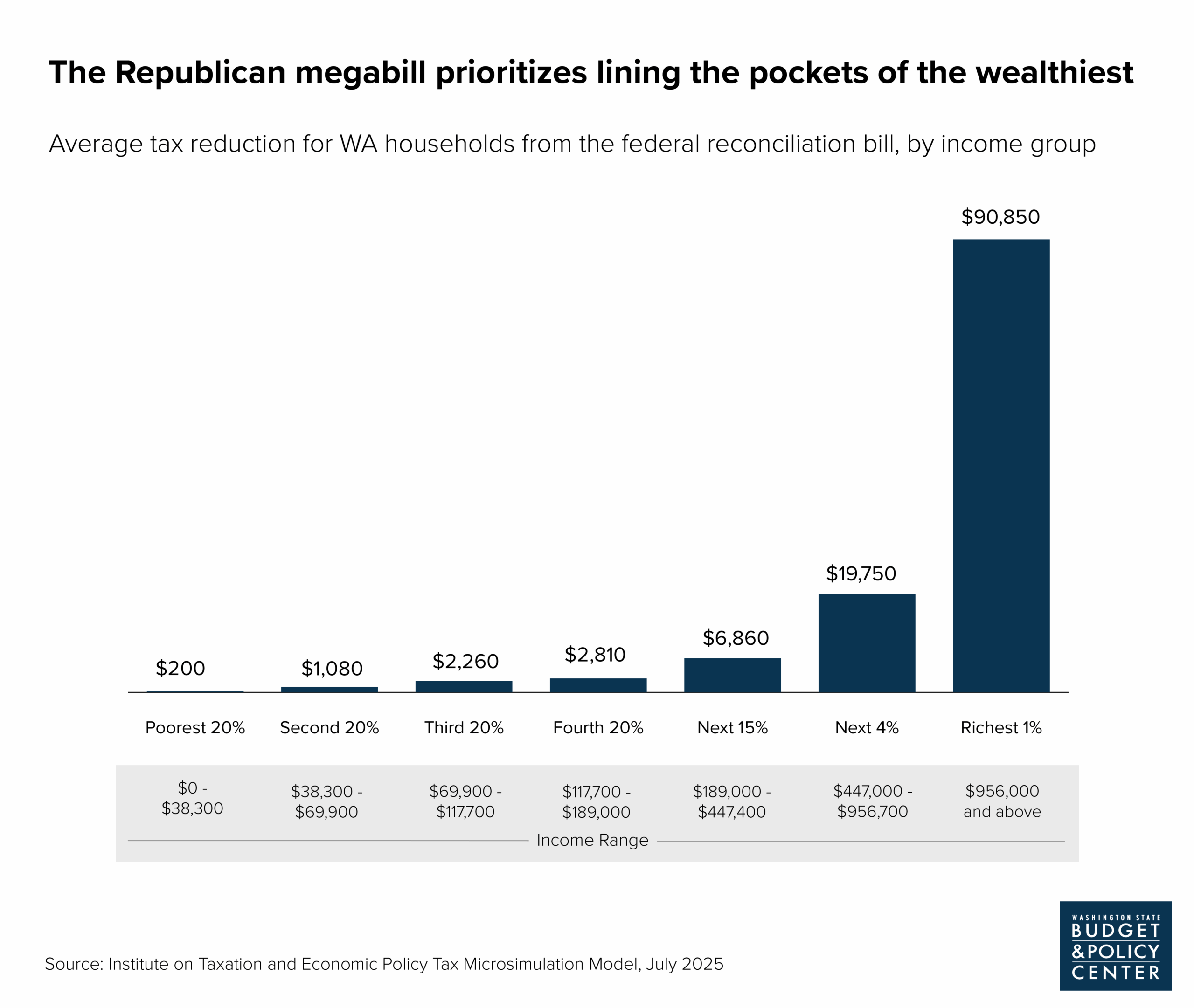
We can do things differently here in Washington state. Lawmakers have levers they can pull to protect working people by ensuring there’s ample funding in our budget for the programs that reinvest in the people who power Washington’s economy. And if there was ever a time for state lawmakers to be bold about supporting our communities, it’s now.
This past November, Seattle passed a fix to our Business and Occupation tax structure that will provide meaningful relief to small businesses while raising revenue by taxing big corporations. Spokane voters approved a major parks levy and school bond on the same ballot, and last year, people across Washington overwhelmingly voted to uphold a capital gains tax on the ultra-wealthy that is helping to fund schools and early learning programs. People across our state are clearly ready for progressive revenue. This legislative session, our lawmakers must step up and join them.
Lawmakers have levers they can pull to protect working people by ensuring there’s ample funding in our state budget for the programs that reinvest in the people who power Washington’s economy. And if there was ever a time for state lawmakers to be bold about supporting our communities, it’s now.
Progressive revenue solutions, which ask the wealthiest people to pay an equitable share of their income in taxes, allow lawmakers to fund the programs that support everyday people, like food assistance and health care. They’d provide support for schools, public health, child care, and transportation. They’d make life just a little bit easier for anyone who’s looking at their monthly bills climbing and climbing and saying, “That can’t be right.”
Given that the majority of us support changing our tax code to fund our public good, our elected leaders should not keep giving in to corporate pressure — especially when the reality is that big corporations continue to generate skyrocketing profits. We saw what happened during the 2025 legislative session when corporate money and power nixed popular progressive revenue options: Lawmakers chose middle-of-the-road, milquetoast tax options, rather than enacting the pragmatic revenue proposals needed to fund critical programs. We continue to face a revenue shortfall in our state in large part because our tax code over-relies on sales and property taxes, while providing major tax loopholes to corporations and the wealthiest few. The sales tax disproportionately impacts low- and middle-income households, while effectively allowing the richest to hoard more wealth. Our west coast neighbors — Oregon, California, and even Idaho and Montana — all have more equitable and functional tax codes.
We can be more like our neighbors. There are tangible solutions that end the cyclical revenue shortfalls, fix our inequitable and out-of-date tax code, and create a more affordable Washington. In the upcoming legislative session, lawmakers should pass pragmatic and popular solutions, like the financial intangibles tax (also called the wealth tax) and the millionaires tax. And they absolutely must reject the myopic and harmful notion that cuts are the best solution to fix shortfalls. As we are facing so many crises of affordability — amid inflation, job losses, and what’s happening on the federal level — lawmakers have to act on these solutions this session.
Eli Taylor Goss is the executive director of the Washington State Budget and Policy Center, a research and policy organization that works to advance economic justice.
Rian Watt is the executive director of the Economic Opportunity Institute, a nonpartisan think tank working to make Washington a national model of economic opportunity.