For the first time, Washington state will have a Millionaires Tax – a historic achievement and a significant step toward equity. The Millionaires Tax represents a big swing at our state’s notoriously upside-down tax code by putting money directly back into the pockets of working families, supporting small businesses across the state, and funding vital public programs.
We’re excited that Governor Ferguson has already come out in strong support of signing the bill into law. As we await this action, we strongly urge Governor Ferguson to maintain the critical wins within the bill to maximize support for Washington households.
How the new Millionaires Tax works
The Millionaires Tax is a new tax in Washington state that, starting in 2029, will apply a 9.9% tax on household earnings over $1 million. At a high level, here’s how it will work:
- The Millionaires Tax only applies to income above $1 million. So if a household makes $1,000,500 in a year, the tax would apply to just $500. The total taxes owed in this scenario would be roughly $50.
- Any household subject to the Millionaires Tax will also have access to up to a $100,000 charitable deduction. In the example above, this means that all $1,000,500 would be exempt from the tax, and no taxes would be owed. Note: The charitable contributions must be made to nonprofits primarily based in Washington state.
- If someone pays Washington’s capital gains tax and earns over $1 million in a year, they’ll receive a 100% credit for the capital gains taxes paid, so there’s no double taxation.
- If someone owns a business and earns over $1 million each year, they’ll get a 100% credit on their Business & Occupation (B&O) taxes paid to the state, which directly reduces any Millionaires Taxes owed.
Because new systems like these take time to set up, this law won’t go into effect until 2029. We nevertheless applaud the legislature for taking action this session so this meaningful and equitable new revenue tool can improve our state tax code and budget in the coming years.
See our most recent FAQ for a comprehensive breakdown of the Millionaires Tax – and stay tuned for updates to the FAQ after the bill is signed into law.
The Millionaires Tax improves the tax code and addresses the rising cost of living with a big expansion to the Working Families Tax Credit
Since the advocate-led passage of the Working Families Tax Credit (WFTC) in 2021, the credit has reached hundreds of thousands of people annually across the state. The credit is an important way Washington state supports middle- and low-income households, providing a direct cash boost of up to $1,330 to cover whatever costs households may need. The WFTC is a targeted approach to provide much-needed relief for working families facing the rising cost of living.
The Millionaires Tax made two key expansions to dramatically extend the reach of the WFTC:
- It removes an age restriction so that low-income young adults and working seniors without children at home can qualify;
- It expands the income limits to reach more moderate-income households. These changes extend the credit to an anticipated 460,000 additional households who are struggling to make ends meet. With this dramatic expansion, a total of around 810,000 households, or over 20% of all households in Washington, are expected to qualify for an extra cash boost through the WFTC in 2029.
These expansions mean more households with children across Washington will benefit. Around 352,000 more children will see benefits from this expansion – that’s almost half of all kids in Washington (47%), up from 25% under the current law.
Click image to enlarge.
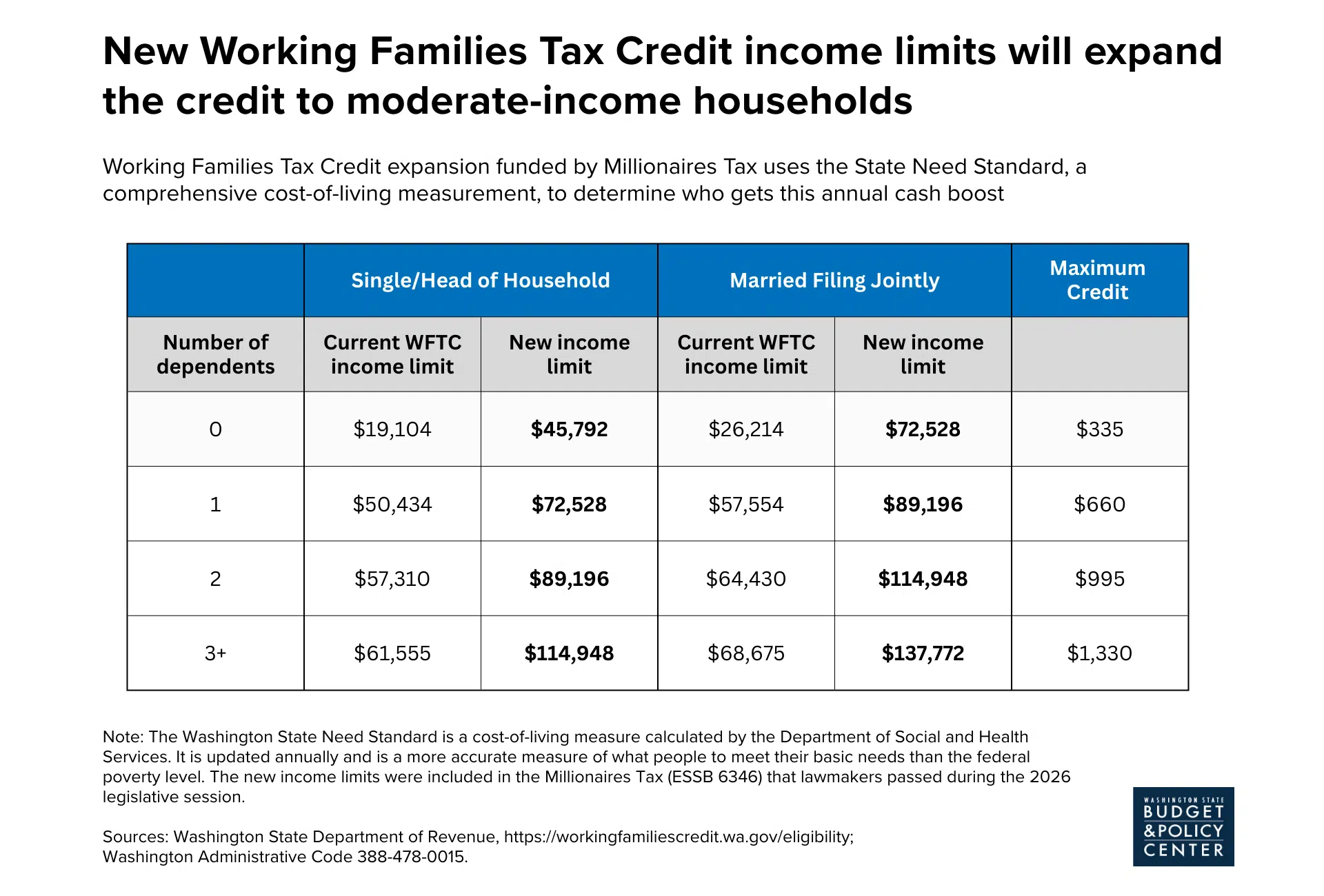
Read more on the Working Families Tax Credit expansion in this blog post, “The Millionaires Tax significantly expands the Working Families Tax Credit.”
How the Millionaires Tax will infuse money into child care and schools and help everyday people with the cost of household items
In addition to providing a cash boost to moderate and low-income households, the Millionaires Tax also provides direct funding to several programs that support the well-being of families and children, including:
- Child-care and early learning funding: Five percent of revenues generated will go to the Fair Start for Kids Account, which helps fund free and low-cost child care and early learning programs.
- Free school lunch for kids: For the first time, all students in Washington will have access to free breakfast and lunch in K-12 schools with funding from this bill.
- No more sales tax on certain common household items: The legislation includes a sales tax exemption for many household items like over-the-counter drugs, diapers, and hygiene products (such as soap, toothpaste, and shampoo).
How the bill supports small businesses, libraries, and schools
One of the driving reasons advocates pushed for the Millionaires Tax is so that the ultra-wealthy in our state, who have gotten a special deal for decades, pay their share of taxes. At the same time, the bill includes critical provisions for small businesses and educational services:
- An increased B&O tax filing threshold for small businesses: If a small business has less than $250,000 in gross receipts, it will no longer have to file nor pay any B&O tax.
- A much larger small business B&O tax credit: The small business B&O tax credit is more than doubled, which means that approximately the first $300,000 of gross receipts will be exempted, with credits gradually phasing out up to $600,000.
- Sales tax exemptions for public libraries and K-12 schools: It exempts sales and use tax on certain services for public libraries and K-12 schools and districts.
As it goes to the governor’s desk, the bill should stay intact
The passage of this historic legislation marks a significant step forward toward fixing our state’s upside-down tax code. (The graphic below from the Institute on Taxation and Economic Policy shows just how big a step it will take.)
Click image to enlarge.

This bill is just what Washington needs to improve our tax code, put money directly back into the pockets of working families, support small businesses across the state, and fund vital public programs. But it’s not over until the governor signs it into law.
It is great that the governor has said that he will sign this bill into law. We urge him to keep the bill as is, without vetoing any parts of it, to maintain these critical funding priorities that would support the economic well-being of people throughout our state.