The passage of the Millionaire’s Tax earlier is a huge win for people and businesses across Washington state. Starting in 2029, the new tax stands to bring in over $3 billion in new revenue annually from roughly 20,000 of the wealthiest households (less than 1% of Washington’s population).
That revenue will be directly reinvested back into communities – by ensuring nearly half a million more households get an annual cash boost (through a massive expansion of the Working Families Tax Credit), funding the largest tax cut for small businesses in Washington state history, providing free meals to all kids in K-12 schools, and eliminating sales taxes from basic hygiene products like shampoo and over-the-counter- drugs (just to name a few of the ways the tax will benefit our state).
However, like many of you, we are also hearing a lot of misinformation about the Millionaires Tax. Some ultra-wealthy people and special interest groups who don’t want to pay this tax are pushing the false narrative of “millionaire tax flight.”
Here are five research-backed reasons that debunk claims that taxes like the Millionaires Tax will make wealthy people move:
1. No one likes to move, and research shows that wealthy households choose where they live for the same reasons that many of us do: to be closer to family, to access good schools, and to seek or maintain jobs. This is well-documented by researcher Dr. Cristobal Young, whose research outlines how millionaires, like everyday people, are embedded within their communities. While there are anecdotes of some households who make the decision to move solely based on tax-avoidance strategies, it is simply not something that happens on a large scale.
2. Evidence from Washington’s capital gains tax and Millionaires Taxes in other states show that the wealthy tend to stay. Washington’s widely popular and revenue-generating tax on capital gains parallels similar support for the Millionaires Tax. After the legislature passed it in 2021, the capital gains tax was upheld by the Washington state Supreme Court in 2022 and then defended by over 64% of Washington voters on the ballot in 2024. The capital gains tax has consistently brought in hundreds of millions of dollars to support early learning, school construction, and low-cost childcare across the state. It’s one of the only revenue-raising tools that ensures that households at the highest-income brackets pay a more proportionate tax in relation to low- and middle-income households.
When the capital gains tax passed, the same misinformation – that the new tax would make rich people leave – was a central argument. However, the tax has consistently outpaced projections, showing that the extremely wealthy few that can afford to pay this tax are not only doing well, they are also staying in Washington. So far in 2026, the capital gains tax has already brought in more than $1.5 billion (this does not include those who received a filing extension), which is nearly three times more than last year. This kind of outpacing is not surprising. In 2023, Massachusetts passed an additional tax on incomes over $1 million through the Fair Share Amendment. They saw actual revenues more than double the initial projections three years in a row and brought in 20% more in 2026 than the year before.
3. Households who will pay the Millionaires Tax are the same households who will get a windfall of over $90,000 annually (thanks to Trump and Congressional Republicans). Last year, Congressional lawmakers chose to line the pockets of the wealthiest households through tax cuts paid for by broad sweeping cuts to healthcare and food assistance. (Read more about the impacts of those cuts in our state.) While everyday people across the state grapple with tough decisions about how to make their housing payments or just keep their health insurance, the richest 1% – the same population who will pay the Millionaires Tax – will receive $90,850 annually from federal tax preferences (or the equivalent to or more than many households’ annual income). Notably, a household would need to make almost $2 million to pay $90,000 in the Millionaires Tax, which would be completely offset by the tax cuts that Congressional lawmakers gave them through H.R.1.
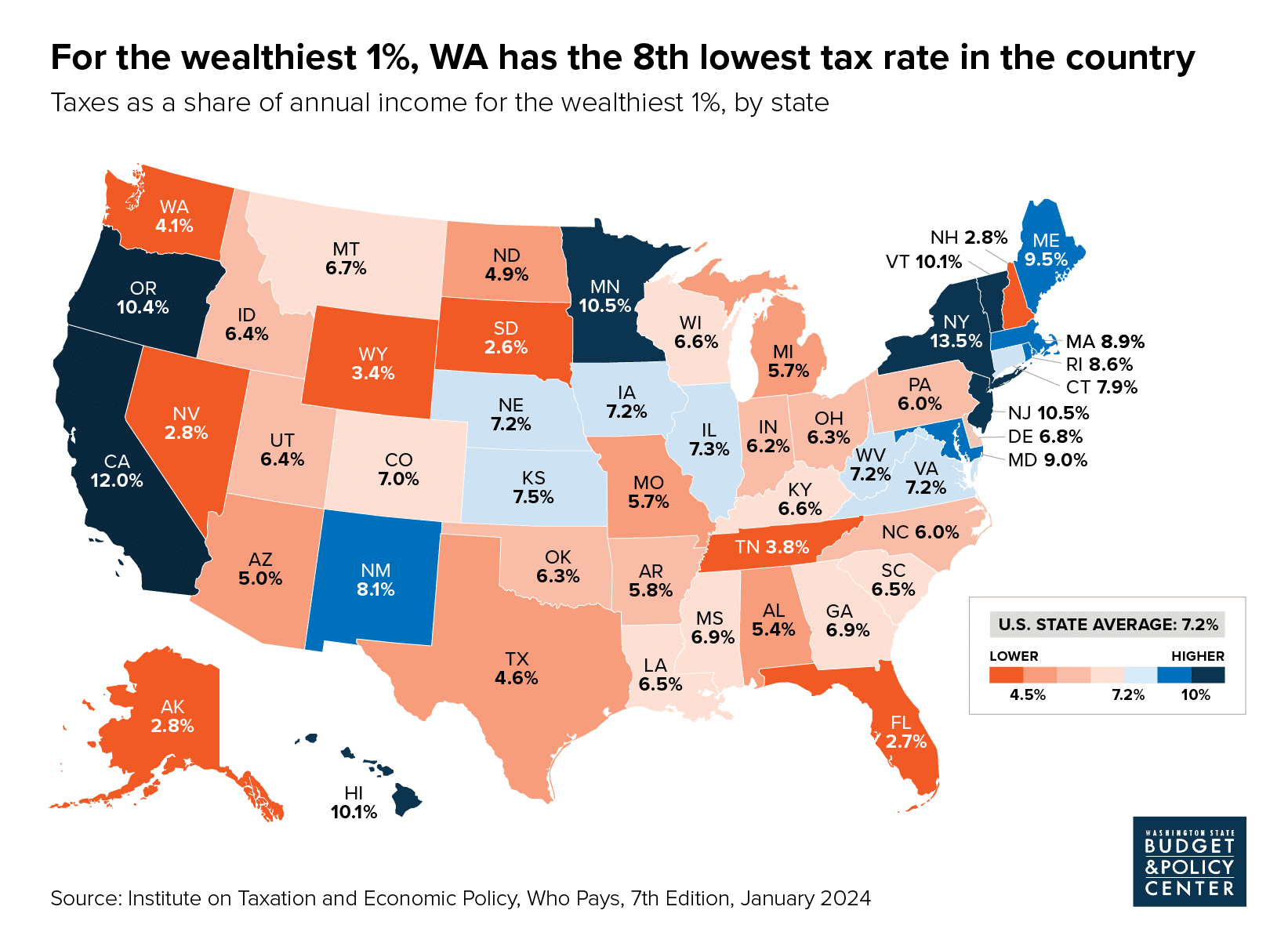
4. The tax rate for the richest 1% in Washington will still be under the national average after the Millionaires tax goes into effect. There’s been a lot of talk about how the Millionaires Tax will impact tax rates and at a core level, it’s important to understand that this tax is a marginal tax – meaning that it’s on just a portion of a household’s total income. So the share of total taxes paid by the top 1% (compared to household income) will be roughly 6.6%, which is still lower than most other states. Even after the Millionaires Tax goes into effect, most of Washington’s neighboring states (Oregon, Wyoming, and California) will have a higher effective tax rate for people making $1 million or more a year.
5. People – including wealthy people – want to live in places that have well-resourced schools, affordable childcare, and good jobs, which is why the economic benefits projected from the Millionaires Tax are a win for us all. The investments from the Millionaires Tax are projected to add jobs to Washington’s economy, provide historic support for small businesses, and increase personal income. New analysis from the REMI Tax-PI model unpacks the economic boost that will come from Millionaires Tax investments, showing that the new tax will result in increased gross domestic product (GDP) and personal income. And it makes sense: The investments slated to support businesses alone will result in the majority of small business owners in Washington seeing historic tax cuts, making it more likely those businesses will be able to stick around. For example, a business owner with $300,000 in gross receipts will get a $4,500 credit to the B&O tax, wiping away potential B&O taxes owed. These important small business supports coupled with the major investments to the Working Families Tax Credit, low-cost childcare, and other important public services, are why Millionaires Tax is projected to add over 20,000 jobs to Washington’s economy and increase personal income by $4.1 billion.
It’s clear that when you look deeper, broad narratives of “tax flight” don’t hold up. And in stark contrast to these false narratives, IRS data reveals that it’s actually low- and middle-income households that are more likely to migrate to other states to access more affordable areas to live.
If you need help understanding the basics of the Millionaires Tax and how it works, check out our FAQ
Popular, accessible, and supportive public programs require robust and sustainable public investment from our tax dollars. And for nearly 100 years, Washington state has given a special deal to wealthy households, all while asking households with the least to pay the highest share of their income in state and local taxes. Relying on such a backwards and upside-down tax code has never been sustainable. And it’s a core reason why we have been facing (and continue to face) large and challenging budget deficits – which have resulted in cuts to essential programs like affordable childcare, higher education, and healthcare.
It’s policies like the Millionaires Tax that help bring our tax code more into alignment with the Washington we all know and love – a Washington with abundant resources, with the ability to make sure all of our neighbors are supported, and one we are proud to call home.