For over a year, Washingtonians from all walks of life have been celebrating a substantial and hard-fought infusion of new funding into their communities for schools and affordable child care. This new funding comes from a tax on extraordinary capital gains that lawmakers passed in 2021 – at the urging of advocates and activists – to help rebalance Washington’s inequitable tax code. Despite the popularity and impact of the capital gains tax, anti-tax groups and a small group of uber-wealthy individuals are working to repeal the tax through the courts (after failing in June to place an initiative to repeal it on the November ballot). The good news is that parents, teachers, small-business leaders, and others are fighting to preserve the capital gains tax and the stronger schools and child care it supports.
Read more about how the capital gains tax will make our tax code more equitable in our blog post, “Taxing capital gains helps repair economic racism.”
If these wealthy interests do succeed through the courts, the richest households – who mostly reside in the greater Seattle area – will take billions of dollars away from rural and other chronically underfunded schools and child-care centers in the coming years. And if they lose in the courts, advocates for the ultra-wealthy may attempt another repeal initiative at some point, even though the initiative they attempted this year (I-1929) proved so unpopular with voters that initiative sponsors dropped attempts to even gather signatures to place it on the ballot.
It is no coincidence that 95% of the contributions to I-1929 came from ultra-wealthy households in the Seattle metropolitan area.1 Of the just 0.2% of Washington households who would get a tax cut from repealing the capital gains tax, a large majority live in King County. In fact, these wealthy King County households would receive two-thirds of the $620 million annual statewide tax cut sought by capital gains tax opponents.2 (See the interactive maps and table below for information on the number, share, and average annual incomes of households in each legislative district who would profit from repealing the state capital gains tax. You can also view a PDF of the data.)
Click on the full screen icon on the Tableau toolbar to see the interactive graphics in full scale.
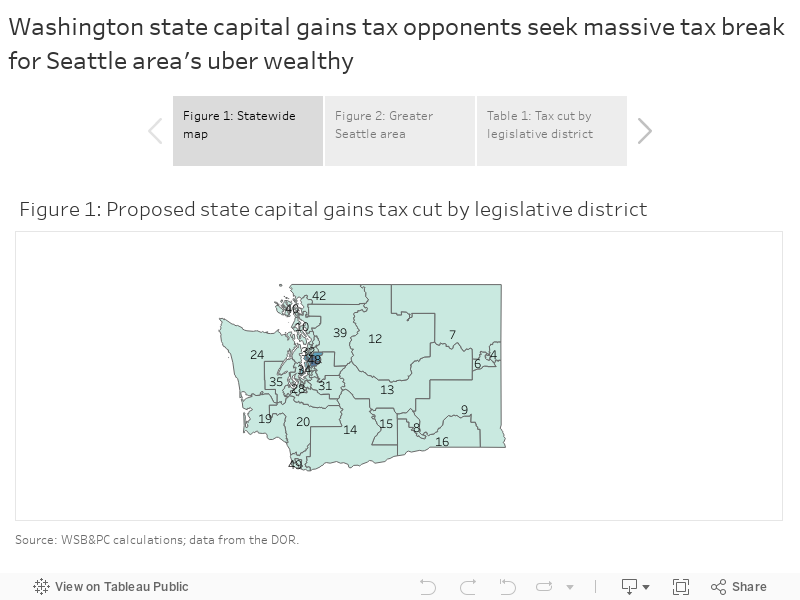
Nearly one-third of all ultra-wealthy households in Washington state who would get a tax cut from repealing the capital gains tax live in just three state legislative districts (the 41st, 43rd, and 48th), which encompass some of the richest communities in King County (and the entire state) – such as Laurelhurst, Medina, Mercer Island, Madison Park, and Redmond. Wealthy households in these districts, whose incomes average $4.9 million annually, would claim nearly 40% of the total capital gains tax cut.
By contrast, far fewer households outside of the Puget Sound region would profit from repealing the capital gains tax. Only 10% of all wealthy households in Washington state who would get a tax cut live in Eastern Washington, while only 8% live in the Olympic Peninsula or Southwest regions of the state.3,4
The bottom line is that the effort by elite investment firms and anti-tax organizations to repeal the capital gains tax is just a ploy to give Washington’s wealthiest households in the greater Seattle area a huge tax cut at the expense of everyone else.
Washingtonians outside of the wealthiest areas aren’t taking the bait, however. In defending the commonsense tax, small-business owners and child care advocates from Wenatchee and other communities in North Central Washington recently cited the critical need for affordable, early learning programs in Central Washington. Another group of advocates and small-businesses owners from North Central Washington rightly argued in a recent brief to the Douglas County Superior Court that the heightened funding for schools and child care enabled by the capital gains tax will strengthen their local economies and help their communities recover and prosper in the coming years. Due to the vigilance of community advocates like these and others working to advance economic justice in rural areas, the capital gains tax remains extremely popular with voters.
Wealthy special interests will continue working to repeal the capital gains tax, thus diverting funding away from communities and into their own pockets. But community leaders from across Washington state, and many Budget & Policy Center coalition partners, will continue fighting to preserve this equitable source of funding for schools and child care.
Some background on Washington state’s capital gains tax:
Signed into law by Governor Inslee in April 2021, the modest 7% excise tax on annual capital gains above $250,000 is exclusively paid by the wealthiest 0.2% of Washingtonians, whose incomes average $2.6 million per year. The tax generates over $500 million per year in new revenue that is dedicated to K-12 schools, a major expansion of child care and early learning supports for young children, and building new schools in communities across the state. Together, the capital gains tax and the Working Families Tax Credit, which people with low and moderate incomes will start receiving in 2023, represent the most equitable adjustment to the state tax code since the early 1930s.