Collectively, consumers in Washington state lose significant funds to unspent gift cards every year. In many other states, after a period of time, companies must try to return unclaimed gift card money to consumers or send the funds to their state’s unclaimed property program to fund public services that benefit communities. Things are different in Washington state because some big business interests – including Starbucks – supported an exemption for gift certificates from unclaimed property law in 2004.
This exemption to the unclaimed property law creates a loophole that incentivizes companies to make it difficult for consumers to use or cash out gift cards. As a result, since 2005, revenue for companies from unclaimed gift cards has exploded. In 2004, Washington’s Department of Revenue (DOR) collected just $2.7 million per year in unspent certificates from all companies incorporated in Washington state. Compare that to this past fiscal year, when Starbucks alone received $215 million in revenue from unredeemed consumer gift cards. (See figure below. Note that “breakage revenue” is a term that describes revenue for services paid for by consumers but never used.)
Click on graphic to enlarge.
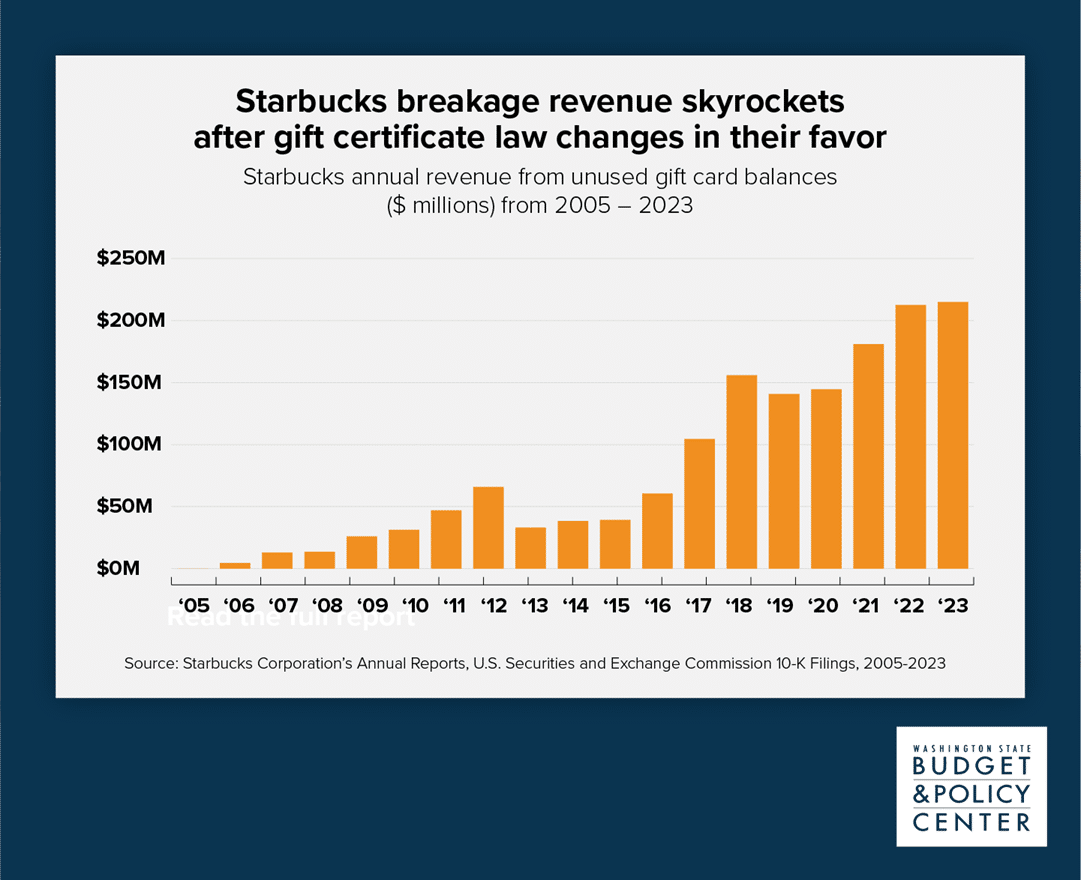
Companies shouldn’t be building millions of dollars of revenue into their bottom lines without providing any goods and services to consumers. This next legislative session, lawmakers should remove this loophole from the unclaimed property law – while exempting small businesses. Our new report, “Unused gift card balances should go back to consumers or help support the public good,” breaks down how unclaimed property works and provides commonsense proposals to put people above corporate profits.
Our elected leaders should pass legislation to make it easier for consumers to use the entire balance of their gift cards and to disincentivize businesses engaged in practices that increase revenue without providing a service. Unspent customer dollars should be returned to those customers or used to fund vital public services like public schools, housing people can afford, and services for those experiencing homelessness or addiction. The Washington State Budget and Policy Center has joined the new Washington Consumer Protection Coalition in calling for a policy that will:
- end the gift certificate exemption from unclaimed property law for large companies;
- make it easier for people to cash out gift card balances under $50;
- encourage companies to alert consumers about unused gift cards with unspent balances;
- enable people to reload their gift cards in any dollar amount they choose; and
- require the ability to split payments between gift cards and other forms of payment.
Instead of allowing an outdated unclaimed property exemption to line the pockets of corporate executives, Washington needs a law that works for people and communities.
View the full Budget and Policy Center report, “Unused gift card balances should go back to consumers or help support the public good.”